

TL;DR
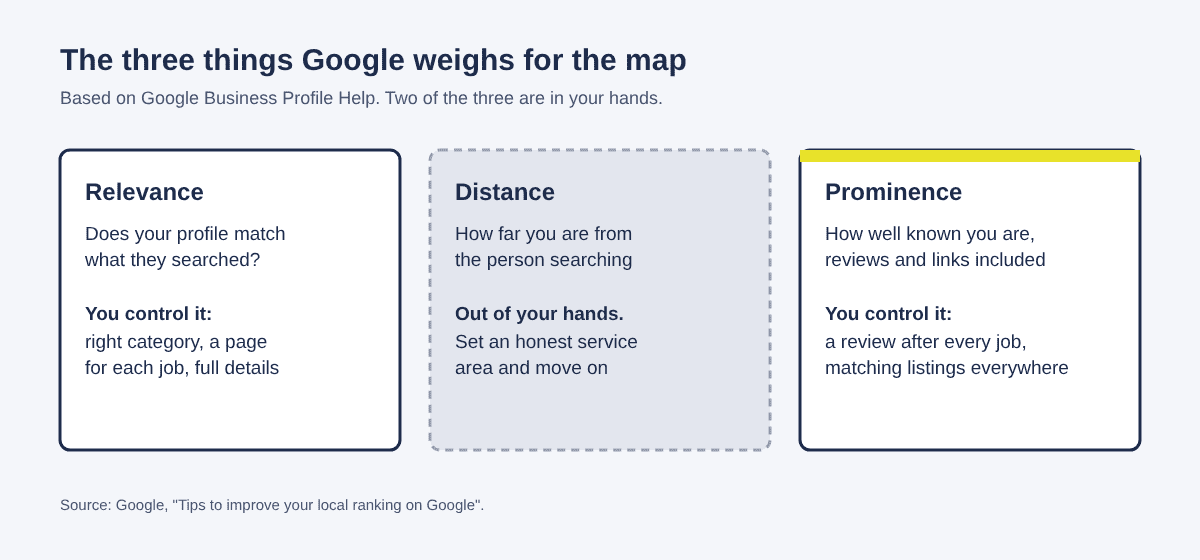
- Google says local results come down mainly to relevance, distance and prominence. You can work on two of the three.
- A complete Google Business Profile with real job photos is usually the fastest fix.
- Asking for a review after every job beats a burst of ten in one week.
- One tile and stone contractor in Folsom, California has 25 Google reviews and over 100 project photos on Yelp. Not huge, just complete.
Short version: you can’t move your shop closer to every customer. You can make Google sure about what you do, and make homeowners sure you’re real.

Local SEO for contractors mostly comes down to convincing Google of two things: what work you do, and that real people nearby trust you. How far you are from the person searching, you can’t change. Nearly everything else, you can.
Let’s make it concrete. Say you run a two-person tile crew in a mid-size town. Your showers and floors are good. You have a website a cousin built, a Google listing you claimed years ago, and almost no calls from search. Here’s how a first month of fixing that could go.
Day one: find out what’s actually broken
Before you change anything, look at what a homeowner sees. Search your trade plus your town on your phone. Then search your business name. Note every place your name, address and phone number show up, and whether they match.
This is the same checkup SmallBiz Marketing starts with for tile setters and remodelers: a look at the website, the Google listing and the contact details, then a short list of what to fix first. You can do a rough version of it yourself in an hour with a notepad.
Week one: fill in the Google profile properly
Your Google Business Profile is your spot on the map. It’s free, and early on it often matters more than your website does.
Pick the category that matches your main trade, not the broadest one on offer. If customers don’t come to you, set a service area instead of showing your home address. Google’s rules for representing your business are strict about using your real business name, with no extra keywords stuffed in. Breaking them can get the listing suspended, which is much worse than ranking low.
Then add your hours, a short plain description and ten or so photos of finished jobs. Real photos of your work, not stock.
Week two: ask for a review after every job
Google says prominence, meaning how well known you are, is partly based on how many reviews you have and how positive they are. So reviews aren’t just decoration. They feed the ranking.
The trick is rhythm, not volume. Ask at the end of every job, while the customer is standing in their new bathroom and feeling good about it. A text with a direct review link works better than a printed card they’ll lose. A steady trickle reads as real. Ten reviews in one week after two quiet years can look odd to a homeowner reading them.
For a sense of what’s within reach: that tile and stone contractor in Folsom has 25 Google reviews, plus a claimed Yelp page with 14 five-star reviews and more than 100 project photos. None of that is huge. It’s just complete, and kept up.
Week three: give each job its own page
Relevance is about how well your listing and website match what someone typed. “Tile installer” is vague. “Walk-in shower tile” plus your town is specific. A page for each job you want more of, with your photos and the towns you cover, gives Google a clear match for that search.
If the website itself needs rebuilding first, this guide to building a website that supports your marketing goals covers the basics.
Week four: make your details match everywhere
Your business name, address and phone number should be the same on Google, Yelp, Apple Maps, Bing and your own site. “St.” on one and “Street” on another won’t hurt you. An old phone number will, because the homeowner who calls it reaches nobody and calls someone else.
Go through the list you made on day one and fix each mismatch. It’s dull work. It’s also the kind most of your competitors never finish.
What local SEO for contractors looks like after a month
Don’t expect the phone to ring off the hook in week five. Local rankings move slowly, and nobody can promise you a spot on the map. What you will have is a complete profile, photos that show your real work, a steady flow of reviews and details that match everywhere. That’s the base everything else builds on, whether you keep doing it yourself or hand it off.